Postpartum anxiety symptoms Indian mothers often dismiss as normal
New mothers are expected to worry. Here's how to tell ordinary new-parent worry apart from postpartum anxiety, and when it's worth talking to someone.
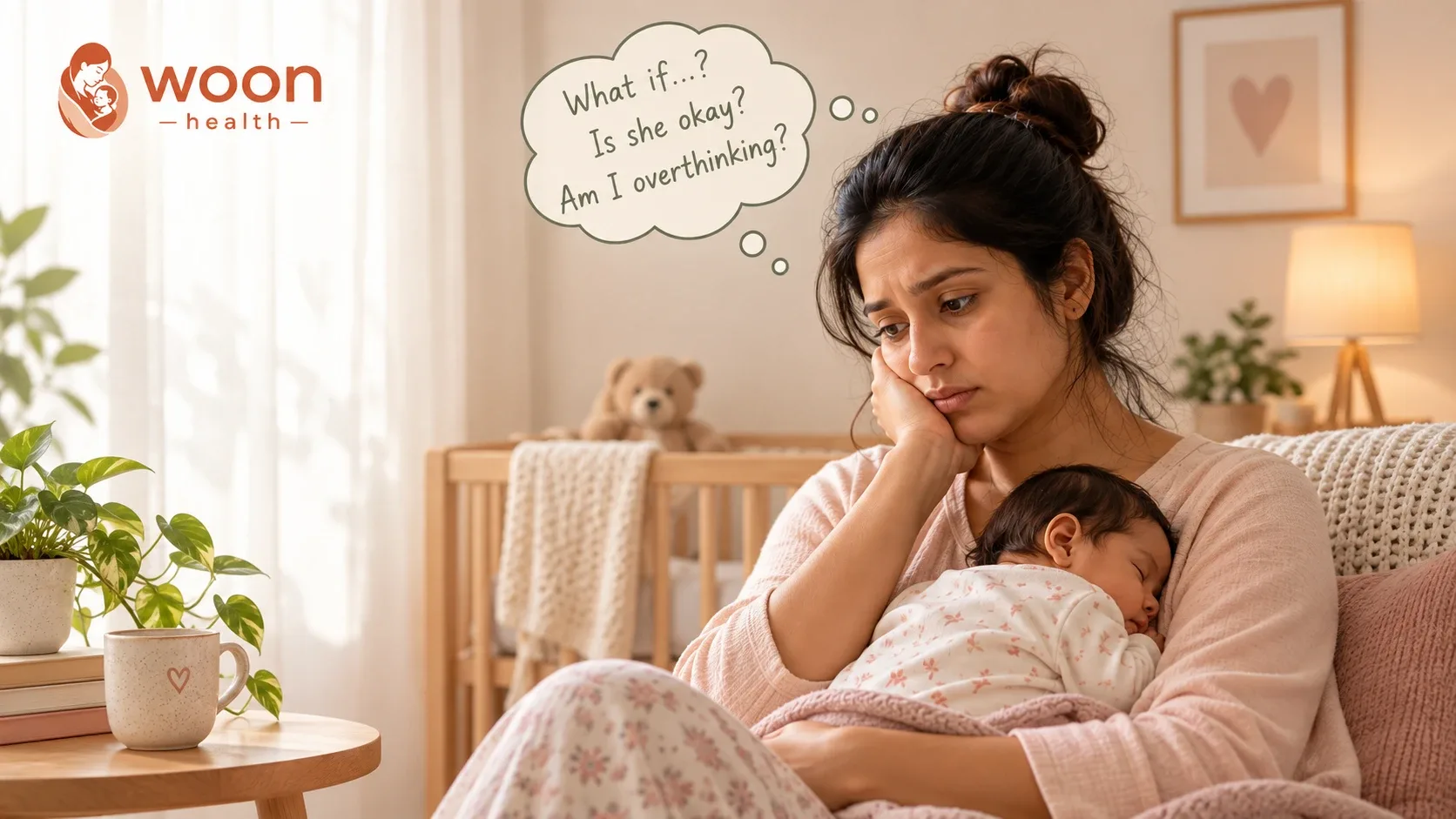
It's 2am. You've already checked on her twice in the last twenty minutes. You check again. Everyone around you calls this being a devoted new mother. Often, that's exactly what it is.
Sometimes it's something else, postpartum anxiety, and the praise it gets is part of why it goes unnoticed.
What counts as ordinary new-parent worry
Some worry after having a baby is expected. Checking on her once before you sleep, asking the pediatrician a question you already half-know the answer to, that's normal. Ordinary worry tends to settle as you find a rhythm over the first few weeks.
What postpartum anxiety actually looks like
Postpartum anxiety is different. It doesn't ease the way ordinary worry does, even after you've checked. It can look like:
- Checking her breathing three times in an hour, and still not feeling settled
- A racing heart when the phone rings, even for a routine call from the clinic
- Re-reading the same parenting forum thread five times, and still not feeling reassured
- Asking your partner “does she look okay to you” more than once in an evening
- Lying awake running through everything that could go wrong tomorrow, even though today went fine
- Feeling wound up or short-tempered, not just worried
Ordinary worry or postpartum anxiety, side by side
| Ordinary new-parent worry | Postpartum anxiety | |
|---|---|---|
| Onset | Settles as you find a rhythm | Can begin any time, doesn't settle on its own |
| Physical signs | Occasional, mild | Racing heart, nausea, restlessness, often |
| Checking behaviours | Reasonable, then you move on | Repeated, brief relief, comes back stronger |
| Daily life | You're tired, but coping | Sleep, function or connection is affected |
A word on intrusive thoughts
Many mothers experience sudden, unwanted thoughts about something happening to the baby, for example, a flash image of her falling, even though you would never let that happen and the thought itself frightens you. These are known clinically as ego-dystonic, the opposite of what you want, and distressing precisely because they clash with how much you love your baby. Having them doesn't mean you're a danger to your child.
This is different from postpartum OCD, a related but distinct condition involving intrusive thoughts paired with repeated compulsions, and different again from postpartum psychosis, a rare psychiatric emergency involving confusion, hallucinations or delusions. If you're not sure which one you're looking at, that uncertainty is a good enough reason to talk to a specialist rather than a search engine.
How common this actually is
Postpartum Support International estimates postpartum anxiety affects up to 20% of new mothers globally, and notes that many of the real symptoms are dismissed as ordinary new-parent worry rather than recognised (postpartum.net).
In Indian clinical settings, the numbers vary by study and screening method. One 2025 tertiary-care hospital study of 600 women found a prevalence of 34% using a validated anxiety scale (Verma et al., European Journal of Cardiovascular Medicine, 2025).
The range is wide because measurement varies, but the direction is consistent. This is common, not rare.
When to seek additional support
While some worry is common in the early weeks, additional support may be helpful if a mother experiences:
- Worry that doesn't ease even after checking, again and again
- Checking behaviours that are taking up real time in her day or night
- Frightening intrusive thoughts that won't quiet down
- Feeling physically wired, racing heart, nausea, restlessness, much of the time
- Thoughts of harming herself or her baby
None of this means she's failing. It means it's time for support, and reaching out is often the fastest way back to feeling like herself.
India-specific mental health helplines
If you need immediate support, you can reach out to:
| Organisation | Phone |
|---|---|
| Tele-MANAS (free, 24/7) | 1800-891-4416 |
| AASRA | +91-9820466627 |
| iCALL (TISS) | 9152987821 |
| Sneha | 044-24640050 |
Questions people ask
Is it normal to worry this much after having a baby?
Some worry is expected, checking on your baby once or twice is normal. The signal to watch for isn't how much you worry, it's whether the worry ever eases. Ordinary worry fades once you've checked. Postpartum anxiety doesn't, no matter how many times you check.
Why can't I relax after having a baby?
It can be a sign of postpartum anxiety, which often shows up as racing thoughts, physical symptoms like a racing heart, and checking behaviours that bring relief for a moment and then come back stronger. It's real, and it's worth naming rather than pushing through alone.
What causes racing thoughts after having a baby?
Racing or looping thoughts, especially about worst case scenarios, are a common symptom of postpartum anxiety. They often come along with physical symptoms like a racing heart, nausea, or shortness of breath.
Why do I keep checking on my baby's breathing?
Checking once or twice is a normal part of new parenthood. Checking repeatedly, without ever feeling settled afterward, can be a sign of postpartum anxiety rather than ordinary caution.
When does postpartum anxiety start?
It can begin any time in the first year after birth. Unlike ordinary worry, which tends to settle as you find a rhythm, postpartum anxiety doesn't ease on its own.